Imranul Ahsan Moonim Trade policy researcher. Teaching Assistant, School of General Education, BRAC University.

Studying trade instruments that help least developed countries retain more value, not just raise volume.

The goal is to turn market access into real integration in global value chains.

Portrait of Imranul Ahsan Moonim in a navy blazer and maroon tie

About

I am an early-career academic at BRAC University, currently co-teaching Emergence of Bangladesh and Community Engagement and Action. My research looks at international trade policy for least developed countries.

I am interested in a simple problem: many of these countries have gained access to global markets and raised their export volumes, yet keep only a small share of the value they help create. I study which trade instruments can change that.

I hold a Bachelor of Social Science in Economics, with a minor in International Development, from BRAC University. I am a published author in economics, and have presented at conferences such as Revisiting Institutions and Incentives, a conference by BIPED, and the National SDG Report. Outside research, I run workshops and one-to-one sessions for students on trade policy, history and civic leadership.

200+

student consultations in a semester

7

workshops conducted

3

conferences and policy forums

Research

Access lets a country sell. Integration decides how much of the sale it keeps.

Most trade preferences for least developed countries are volume-linked. If goods qualify, they enter duty-free, and the benefit grows with how much is shipped. That has raised exports. It has not, on its own, raised the share of value created at home. My work asks what a value-linked instrument would look like: one that keeps entry simple but rewards a rising share of domestic value.

The smile curve of value added A smile curve. Stages of making and selling a product run along the bottom: inputs, design, processing, assembly, logistics, branding and finance. Value added is high at both ends and lowest at assembly, where most least developed country exporters sit. Arrows from assembly point up both sides of the curve, toward more value and integration. Value added InputsDesignProcessingAssemblyLogisticsBrandingFinance Move up the chain Integration Where most LDC exporters sit The smile curve of value added A smile curve. Stages of making and selling a product run along the bottom: inputs, design, processing, assembly, logistics, branding and finance. Value added is high at both ends and lowest at assembly, where most least developed country exporters sit. Arrows from assembly point up both sides of the curve, toward more value and integration. Value added InputsDesignProcessingAssemblyLogisticsBrandingFinance
Value added across the stages of making and selling a product. Most least developed country exporters sit at assembly, the lowest point. Volume-linked preferences reward shipping more from there. Value-linked ones would reward moving up either side. This is a general pattern described in value chain research, not measured data. I make the full case in From access to integration.

Ongoing work: which trade instruments help least developed countries keep more value?

An initial investigation into rules of origin, graduation rules, export incentives and safeguards, starting with Bangladesh's garment sector.

Read the essay

Publications

Academic

Bangladesh RMG: Winning Despite the Bottlenecks

SSRN

A case study of how Bangladesh's garment industry stays globally competitive on volume despite weak logistics and infrastructure, and the strategy options for staying competitive.

Working paper, SSRN

Read on SSRN

Economics of Leisure

2023

A peer-reviewed paper on leisure time and mental health among 100 working-class Bangladeshis. It finds a threshold relationship between leisure and well-being.

BRAC University Students' Economics Journal, Vol. 1, Issue 1

Visit the journal

Non-academic

Mind the Consumer

2026

With living costs rising faster than wages, Bangladesh needs a regularly published national Consumer Confidence Index to track how households see their situation.

ICE Business Times

Read the article

Medicine for All

2023

An opinion piece on what the end of the TRIPS waiver means for Bangladesh's medicine exports and prices after LDC graduation.

New Age

Read the article

Courses I co-teach

School of General Education, BRAC University

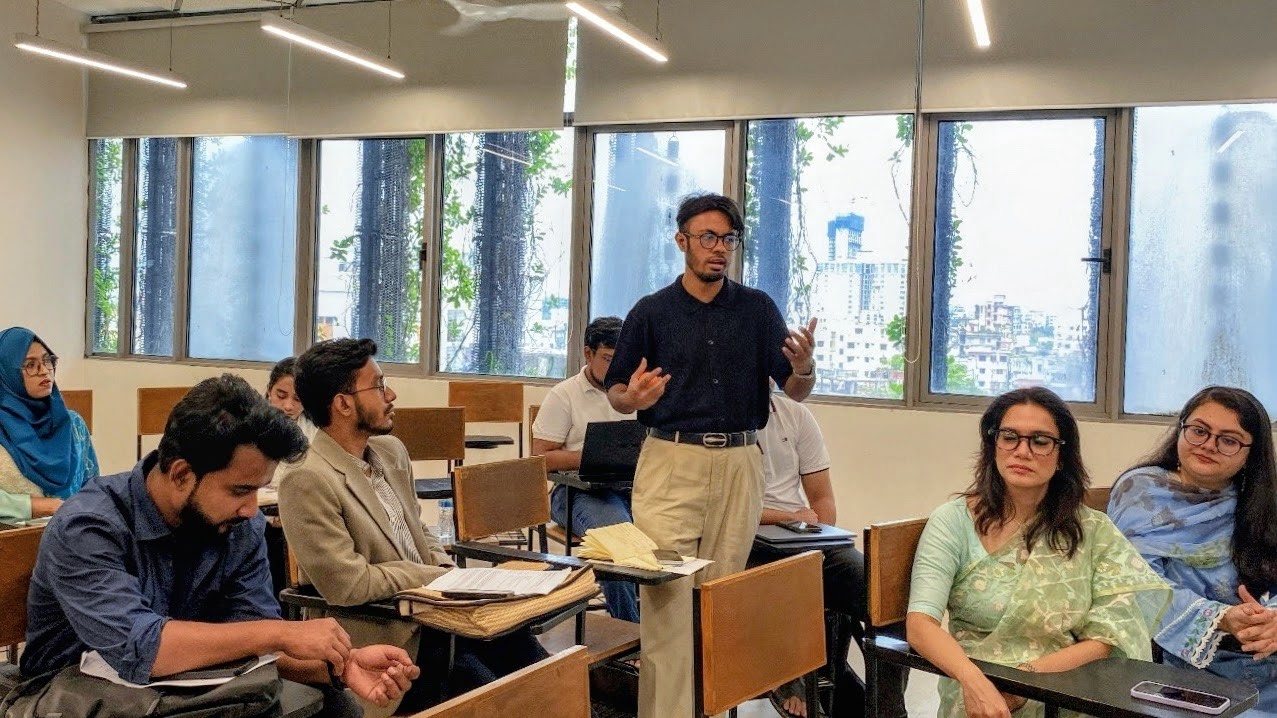
Imranul standing and speaking in a classroom while people seated around him listen

Emergence of Bangladesh

EMB101

A course on the history, politics and economy of Bangladesh. It runs from ancient and medieval Bengal through colonial rule, the Language Movement and the Liberation War of 1971, to the constitution and development after independence.

My role: I help students understand core concepts and spot historical patterns, assist with assignment planning, structure review and grading, hold consultations, and co-teach selected classes with faculty members.

Course outline (PDF)

Community Engagement and Action

BU201

A project-based course taken alongside Emergence of Bangladesh. Students study community, active citizenship, the SDGs in Bangladesh and the ethics of community work. They then spend four weeks in groups on a real project with a community partner and reflect on what they learned.

My role: I support class discussions and group work, guide project teams during the immersion weeks, and give feedback on reflections and presentations.

Course outline (PDF)

Students can book a 15-minute session with me to talk through coursework, assignments or research ideas.

Book a session